
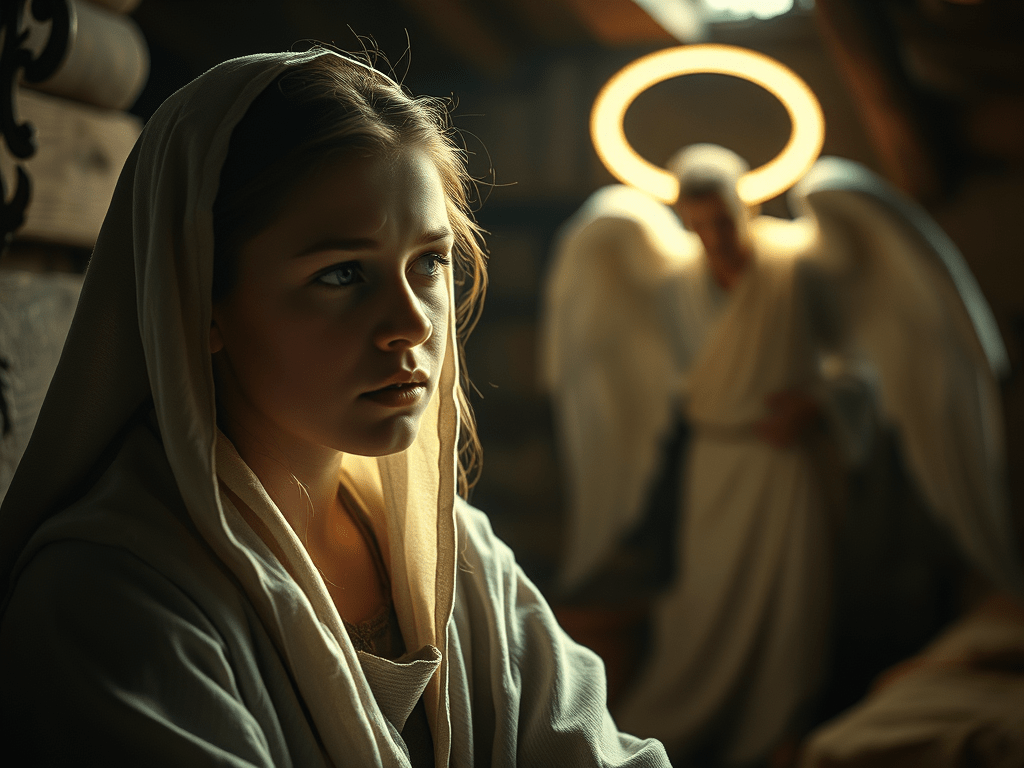
Luke 1:26–38 – Advent 1: Hope
Friends, Advent begins not with a cozy scene, but with an interruption. The world around Mary is occupied, unjust, anxious. Our world is not so different: climate crisis, war, economic pressure, loneliness, and the ache many carry quietly.
Into that kind of world, God speaks a “Yes.” Luke 1:26–38 shows us that “Yes” taking shape,
vv. 26–27 – God’s “Yes” begins in Nazareth
“In the sixth month the angel Gabriel was sent by God to a town in Galilee called Nazareth, to a virgin engaged to a man whose name was Joseph… The virgin’s name was Mary.”
The story begins not in a palace or a temple, but in Nazareth—a nowhere kind of place. The word translated “virgin” here points to a young unmarried woman. Early Christians also heard echoes of Isaiah 7, where a “young woman” would bear a child as a sign of hope. Over time, that Scripture shaped how they told the story of Jesus’ birth.
Either way, this much is clear: God’s “Yes” comes through the body of a young woman in a patriarchal culture, where an unexplained pregnancy could mean shame, rejection, even danger.
Hope does not land in a safe, neutral space. It lands in a body that can be harmed.
From the very first verse, Luke is telling us: God’s future is entrusted to those the world treats as small.
vv. 28–29 – Troubled by grace
“And he came to her and said, ‘Greetings, favoured one! The Lord is with you.’ But she was much perplexed by his words and pondered what sort of greeting this might be.”
We often picture Mary serene and unruffled. Luke says she is disturbed and thoughtful. “Favored” does not feel flattering; it feels unsettling. The phrase “The Lord is with you” is the language God used for Moses, Joshua, Gideon.
Mary stands in that line of called servants, but the calling does not feel comfortable.
Hope usually starts that way. It does not simply reassure us. It raises questions: Why me? What now? What will this cost?
vv. 30–33 – A promise bigger than her life
“The angel said to her, ‘Do not be afraid, Mary, for you have found favor with God… You will conceive… and name him Jesus.
He will be great, and will be called the Son of the Most High… and of his kingdom there will be no end.’”
“Do not be afraid” is what messengers say when God draws close. The promise is huge: a child who will bear God’s life, a reign that will not end. In an empire that calls Caesar “son of god” and “lord,” this is daring language. God’s “Yes” is not a vague feeling; it is a new kind of rule, a different way of ordering the world.
To say Christ is God’s “Yes” is to trust that love, justice, and mercy will outlast every empire, every war, every regime. That is a big claim to make when the news is bleak. Yet Advent invites us to stand in that claim.
v. 34 – Honest questions
“Mary said to the angel, ‘How can this be, since I am a virgin?’”
Mary does not nod politely. She asks a practical question. In Greek, she literally says, “I am not knowing a man”—this is not how pregnancies work.
Here is good news for anyone who has been told that faith means swallowing your questions. Mary’s hope is not naïve. She wants to know how this will work.
That is an important question. At the very least, the gospel gives her voice, thought, and the right to ask.
Hope, in Scripture, is not blind. It is allowed to say, “How can this be?”
vv. 35–37 – Overshadowed by the Spirit
“The angel said to her, ‘The Holy Spirit will come upon you, and the power of the Most High will overshadow you… For nothing will be impossible with God.’”
The language of “overshadowing” recalls God’s presence resting on the tabernacle, the Spirit hovering over the waters at creation. Mary’s body becomes a kind of living sanctuary, a place where new creation begins.
Many scholars, including Dan McClellan, remind us that these birth stories are also theological storytelling. The early church reached back into Israel’s Scriptures to say: This is the kind of God we have known all along—bringing life where it cannot be, keeping promises in ways we never expected.
Echo of God’s word to Sarah in Gen 18:14; ties Mary’s story to long line of “impossible” births and God’s fidelity.
That does not erase the difficulty of the promise. “Nothing will be impossible with God” is not a slogan for magical thinking. It is a whisper of hope spoken into very real limits.
Faith can include perplexity, questions, and fear, not just certainty.
v. 38 – A costly “Yes”
“Then Mary said, ‘Here am I, the servant of the Lord; let it be with me according to your word.’”
This is the turning point. Mary names herself as God’s servant, and she consents.
In a society where her body and future were already controlled by others, her “yes” is both costly and courageous.
the Spirit’s overshadowing and the unexpected pregnancy as divine disruption of “normal” kinship patterns and gender expectations, creating new family and belonging in God
This verse has been misused to tell women to accept suffering and abuse as “holy.” That is not the call of God.
In fact, if Mary’s “yes” is to mean anything, we must also honor the power of “no.” Consent is only real where refusal is possible.
The church does not honor Mary by preaching submission to harm; we honor her by standing with all whose bodies bear the cost of injustice.
Mary’s “yes” invites us toward a different obedience: the kind that joins God’s work of lifting the lowly, feeding the hungry, sheltering the vulnerable.
Hope as resistance in a weary world
So what does this mean for us, in our own Nazareths?
We live in a world where many feel disposable: migrant women, young people facing impossible choices, queer and trans neighbours whose bodies are debated and denied, elders isolated and afraid.
We live in a creation groaning under climate change, in economies that strain families, in a culture that often says “no” to those who do not fit its mold.
Into that world, Advent proclaims: God’s answer in Christ is still “Yes.”
Not “yes” to everything that happens. Not “yes” to violence, prejudice, or greed. God’s “Yes” is a person—Jesus—through whom the Holy One says:
- Yes to the poor and the humble.
- Yes to those pushed to the margins.
- Yes to life stronger than death, love stronger than fear.
To welcome Christ, then, is to dare to hope again. Not because everything looks hopeful, but because God’s “Yes” has already begun in places that looked impossible.
This Advent, perhaps the question for us is Mary’s: How can this be? And perhaps the invitation is Mary’s as well: to offer our own thoughtful “Here am I,” with clear boundaries, with honest questions, and with a willingness to stand alongside those whose bodies still carry the cost of the world’s “no.”
Christ is God’s “Yes” to a weary world. May that “Yes” take flesh in us. Amen.
 Reverend Marco Ste-Marie
Leave a comment