
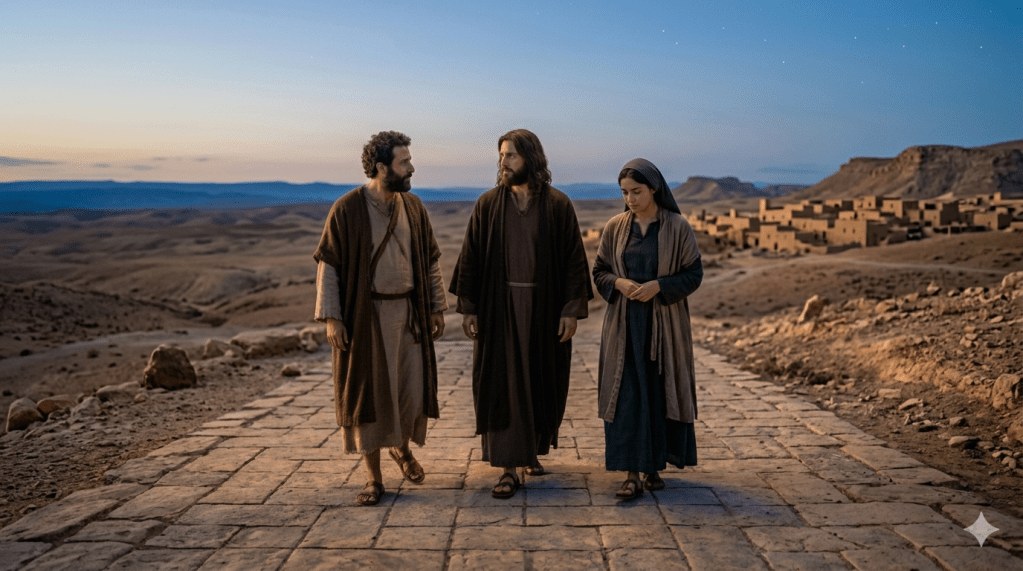
Luke 24:13–32
I want to begin with something simple and human.
Not seeing clearly is part of life.
A little while ago, I spent several minutes looking for my phone. I checked the table, the kitchen, my coat pocket, the couch cushions.
I was growing frustrated. And then I realized I had been holding it the whole time.
It is funny when that happens with a phone.
It is not funny when it happens with people.
It is not funny when it happens with injustice.
Because sometimes what we fail to see is not small.
There is pain we miss.
There is injustice we live beside.
There is harm we may even help carry forward without meaning to, simply because it has become familiar, acceptable, and normal to us.
A pattern of harm so familiar that we stop noticing it and start calling it normal.
And that is not easy to admit.
We all have blind spots.
A blind spot is not always a sign that we are cruel.
Sometimes it is a sign that we are comfortable.
Sometimes it is a sign that we have lived too long inside a certain way of seeing the world, and we have forgotten to ask who is being hurt by what feels normal to us.
And that is where today’s gospel meets us.
Two disciples are walking the road to Emmaus. It is Easter day, but they do not feel Easter joy. They feel loss. Confusion. Disappointment. The future they had imagined has fallen apart.
The one they trusted has been crucified. Their hope has been shaken.
Then Jesus comes alongside them.
The risen Christ is right there, walking beside them, and they do not know it.
Luke tells us that their eyes were kept from recognizing him.
That matters. The story does not shame them for not seeing. It does not laugh at them. It does not paint them as foolish.
It simply tells the truth: they could not yet see what was right in front of them.
That is not only their story. It is ours too.
There are things right in front of us that we do not yet see.
There are forms of injustice built into ordinary life that can remain invisible to those who are not crushed by them.
And if we are honest, sometimes we are not only blind to injustice. Sometimes we are also part of it.
Not always by cruelty.
Not always by bad intentions.
But by habit.
By comfort.
By silence.
By accepting as normal what should never have become normal.
That may be the hardest truth of all.
There are times when we benefit from systems we did not create, and because they work in our favour, we rarely question them.
There are times when other people are carrying costs we do not have to carry.
There are times when the church, too, has mistaken comfort for peace, order for justice, politeness for love, and silence for unity.
There are times when we look away because looking closely would ask something of us.
Because we confuse our comfort with peace.
Because we confuse avoiding tension with being loving.
Because we would rather be reassured than changed.
And yet the gospel does not begin there with blame. It begins with Jesus drawing near.
That matters.
Because Luke does not tell this story to shame them. He does not tell it so we can laugh at how little they understood.
He tells it because this is how human beings so often live: with grace beside us, truth near us, pain around us, and still we do not see.
And if that can happen with Jesus himself walking at their side, then surely it can happen to us.
That is the mercy in this story.
Jesus comes beside these disciples before they understand anything. He comes near before they have the right words, before they have clarity, before they can name what is true.
He meets them in their confusion. He walks at their pace. He listens to their grief. He stays with them long enough for recognition to grow.
That is how Christ meets us too.
Not first with condemnation, but with presence.
Not first with accusation, but with truth wrapped in grace.
Not first to crush us, but to open us.
So when we speak today about blind spots, complicity, and injustice, this is not meant to humiliate anyone.
It is meant to help us become more honest, more awake, more loving, more faithful.
Because if we do not admit that we have blind spots, then we will defend them.
And if we defend them, then we protect the very harm God is trying to heal.
The pain in this world is not always far away. It is often very near.
It is the person who cannot afford to live in the town where they work.
It is the elder who feels forgotten.
It is the neighbour who does not feel safe being fully themselves.
It is the person whose story is dismissed because it makes others uncomfortable.
Sometimes this pain is under our very eyes. Sometimes it is even under our care. And sometimes we do not see it because we have learned not to see it.
We get used to things.
We get used to certain voices being ignored.
We get used to patterns that leave some people carrying more than their share.
We get used to language that wounds.
We get used to decisions made for people rather than with them.
We get used to suffering that does not belong to us.
And once we get used to something, we can start calling it normal.
But normal is not always just.
Common is not always holy.
Familiar is not always faithful.
The Emmaus story invites us to let Jesus interrupt what has become normal.
He interrupts despair.
He interrupts the misunderstanding.
He interrupts the story the disciples thought was over.
And perhaps today Christ wants to interrupt us too.
To interrupt our assumptions.
To interrupt our comfort.
To interrupt the small stories we tell ourselves so that we do not have to face the larger truth.
Yet notice how this opening of the eyes happens.
It does not happen through force.
It does not happen through public shame.
It happens in companionship, Scripture, hospitality, and the breaking of bread.
Their eyes are open in relationship.
That matters because seeing clearly is rarely a solo act.
We need each other.
We need the stories of those whose lives are not like ours.
We need to listen when someone says, “This is hurting me,” even if we had never noticed it before.
We need the humility to believe that another person may see something we have missed.
We need communities of faith that help each other wake up, not to despair, but to responsibility.
Maybe that is part of the church’s calling: to become a place where people can tell the truth about pain, where hidden harm can be named, where blindness is met not with ridicule but with repentance, and where repentance actually leads somewhere.
Because in the Bible, seeing is never just about noticing.
Seeing leads to turning.
Turning leads to change.
Change leads to action.
The disciples do not say, “Well, that was meaningful,” and then return to life as usual.
No. Once their eyes are opened, they get up. They go back. They move toward the others. Recognition changes their direction.
That is the word for us.
If Christ opens our eyes to pain, then we cannot keep pretending not to see it.
If Christ opens our eyes to injustice, then we cannot go back to blessing what harms people.
If Christ opens our eyes to our own complicity, then our task is not self-hatred.
It is repentance. And repentance means change.
It means asking different questions.
Who is carrying the burden here?
Who is being left out?
Who pays the price for this “normal” arrangement?
Whose voice have we not heard?
What have we accepted because it is convenient, even though it is not loving?
Where have we confused our comfort with God’s will?
These are not easy questions. But they are holy questions.
And here is the good news: God does not open our eyes in order to leave us in despair.
God opens our eyes so that we can become more faithful. More tender. More just. More brave.
The point is not to feel crushed by all we did not know yesterday. The point is to respond faithfully to what we can see today.
Today, perhaps you can listen without defensiveness.
Today, perhaps you can question a pattern you once took for granted.
Today, perhaps you can speak up where silence has protected harm.
Today, perhaps you can choose solidarity over comfort, courage over denial, love over habit.
That is how the world changes. Not only through grand gestures, but through opened eyes and changed hearts that lead to concrete acts of care and justice.
So let us not be afraid of what we do not yet know.
Let us not be afraid to admit that there is suffering we have missed and injustice we have normalized.
Let us not be afraid to confess that there are ways we have been shaped by systems that are not of God.
Because Christ still comes to us on the road.
Christ still comes to us in the breaking of bread.
Christ still comes to us in the voice of those whose pain we did not want to see.
Christ still comes, not to shame us, but to wake us.
And maybe the question for us this morning is not, “How could I have missed it?”
Maybe the question is, “Now that I can see a little more clearly, what will love require of me?”
May God give us the grace to see.
May Christ stay close as our hearts are opened.
May the Spirit give us courage to name what is wrong, to turn from what harms, and to do the good we can now do.
Amen.


Leave a Reply