
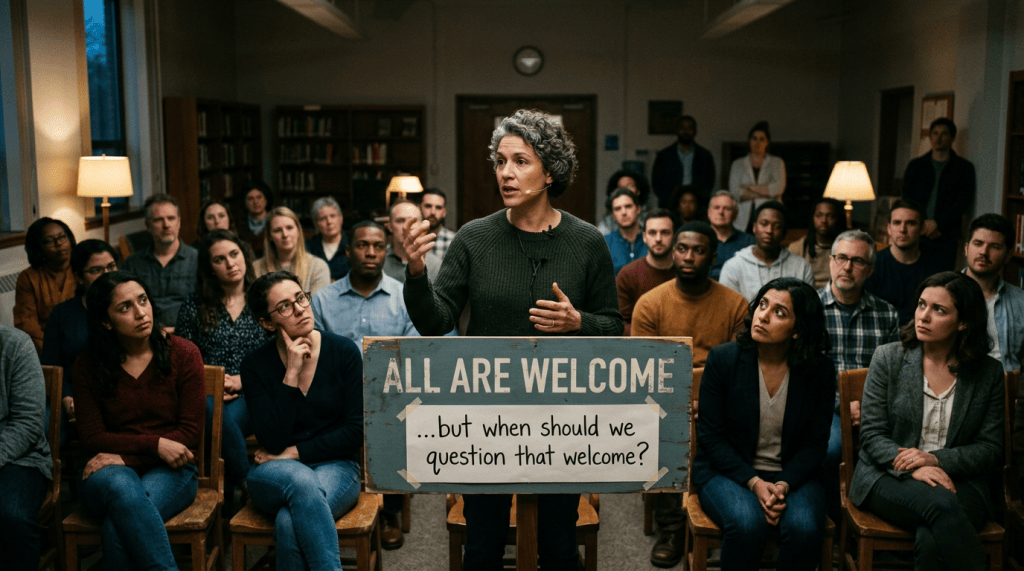
When radical hospitality becomes an excuse for avoiding accountability.
“All are welcome.”
Three simple words.
We see them on church signs, websites, Sunday bulletins, and banners hanging outside our buildings. We say them with pride. We repeat them as though they are a declaration of who we are and what we believe.
And they should be.
But I wonder whether we have spent enough time asking ourselves what those three words actually mean.
When we say all are welcome, what exactly are we promising?
Are we saying that divorced people are welcome, without judgment, shame, or the suggestion that their lives somehow fall short of God’s expectations?
Are we saying that single parents are welcome, without assumptions about their circumstances or questions about how they came to raise their children alone?
Are we saying that LGBTQ+ people are welcome, not merely tolerated, not welcomed on the condition that they change, remain silent about their identities, or become more acceptable to someone else’s understanding of Christianity? Are we saying they belong fully, exactly as they are?
Are we saying that people of other religions are welcome, that we will honour their spiritual traditions without treating their presence as an opportunity to convert them?
Are we saying that atheists and agnostics are welcome, that their questions, convictions, doubts, and perspectives are valuable, and that they can belong to our community without being expected to believe what we believe?
Are we saying that someone who is hungry will find more than a friendly smile? That we will offer them something to eat?
Are we saying that people who are struggling financially, emotionally, or socially will not be made to feel like outsiders because their lives do not resemble ours?
Are we saying that people can enter our churches with questions, uncertainties, painful histories, and different beliefs and still find a place where their dignity is respected?
If this is what we mean by all are welcome, then I wholeheartedly embrace those words.
This is the kind of welcoming community I believe the Gospel calls us to become.
But there is another side to this conversation. One that churches, particularly those of us who pride ourselves on being open, inclusive, and progressive, sometimes find remarkably difficult to address.
Does welcoming everyone mean accepting every behaviour?
And if we are unwilling to ask that question, have we truly understood what love requires of us?
When Welcome Becomes Permission
Suppose someone consistently intimidates other members of the congregation. They belittle volunteers, manipulate conversations, undermine leadership, or make others afraid to speak honestly.
Do we simply shrug our shoulders and say, “Well, all are welcome”?
Suppose someone behaves aggressively, threatens others, or repeatedly crosses personal boundaries.
Do we avoid confronting the behaviour because we don’t want to appear judgmental or unchristian?
Suppose someone has a known history of serious financial misconduct in another congregation. Do we immediately place them on our finance committee, without safeguards or a process of rebuilding trust, because we believe everyone deserves a fresh start?
Suppose someone repeatedly causes harm, refuses to acknowledge it, and continues to disrupt the life of the community.
Do we allow it to continue indefinitely because challenging them might create conflict?
At what point does our commitment to being welcoming become an excuse for refusing to exercise responsibility?
At what point does kindness become avoidance?
And at what point does our desire to appear loving actually permit harm?
These are uncomfortable questions. But they are necessary ones.
Because there is a profound difference between welcoming a person and giving that person unrestricted permission to behave however they wish.
A person can be welcomed without being given authority.
A person can be loved without being trusted with every responsibility.
A person can be treated with dignity while still being held accountable.
And a person can be invited into community while being told, clearly and compassionately, that certain behaviours will not be tolerated.
None of these things contradicts Christian love.
In fact, I would argue that they are expressions of it.
The Dangerous Confusion Between Love and Niceness
Somewhere along the way, many churches seem to have confused being Christian with being nice.
We have become uncomfortable with disagreement. We hesitate to challenge destructive behaviour. We worry that setting boundaries might offend someone, create tension, or make us appear less welcoming.
We sometimes act as though Christian love requires us to be endlessly accommodating, endlessly patient, and endlessly forgiving, regardless of the consequences.
But love is not the absence of conflict.
Compassion is not the avoidance of difficult conversations.
And forgiveness is not the cancellation of accountability.
Jesus did not teach a spirituality built around keeping everyone comfortable.
He welcomed people whom society rejected. He shared meals with those considered unworthy. He crossed religious, cultural, and social boundaries. He challenged systems that excluded and humiliated people.
But he also confronted hypocrisy. He challenged those who used their power to exploit others. He criticized religious leaders who placed burdens on vulnerable people while protecting their own positions.
He overturned tables in the Temple.
Whatever else we make of that story, it is difficult to imagine Jesus believing that maintaining a pleasant atmosphere was always more important than confronting injustice.
His compassion was not passive.
His love was not indifferent to harm.
His welcome did not require silence in the presence of exploitation.
And neither should ours.
Who Pays the Price for Our Silence?
This is perhaps the question that troubles me the most.
When a church refuses to address harmful behaviour, who actually pays the price?
Usually, it is not the person causing the harm.
It is the quiet volunteer who eventually stops coming because they cannot tolerate being belittled one more time.
It is the newcomer who was excited to find community but discovers that certain personalities control everything.
It is the elderly person who feels intimidated but doesn’t want to cause trouble.
It is the young person who learns that speaking up about inappropriate behaviour will make them the problem rather than the behaviour itself.
It is the child whose safety depends on adults being willing to establish and enforce boundaries.
It is the exhausted committee member who has spent years managing someone else’s outbursts while everyone else looks away.
And sometimes, it is the minister, staff member, or volunteer who is expected to absorb mistreatment in the name of Christian service.
Eventually, these people grow tired.
Some withdraw quietly.
Some lose their confidence in the community.
Some leave the church altogether.
And when they leave, we may wonder why.
We may blame changing cultural attitudes, declining religious participation, or a society that seems less interested in Christianity.
But perhaps, sometimes, we need to ask a more difficult question.
Have some people left the church not because they stopped believing in Christ, but because they could no longer recognize Christ in the way the church treated them?
That possibility should trouble us deeply.
For some people, the church was supposed to be a place of healing.
They arrived carrying wounds from families, relationships, workplaces, or previous religious communities. They hoped to discover a place where they could feel safe, valued, and respected.
Instead, they encountered the very behaviours they had hoped to escape.
And worse, when those behaviours were brought to the attention of the community, they were sometimes met with silence, excuses, or appeals to forgiveness.
Imagine the spiritual damage that can cause.
Imagine being told that you are loved by a community that refuses to protect you from someone who repeatedly hurts you.
What does our welcome mean then?
The People We Protect Reveal What We Value
We often measure the success of a welcoming church by how many people feel comfortable entering its doors.
Perhaps we should also measure it by how safe people feel once they are inside.
Do children feel protected?
Do vulnerable adults feel respected?
Can volunteers express concerns without fear of retaliation?
Can someone disagree with a long-standing member without being punished socially?
Can a newcomer participate without having to navigate unhealthy power structures?
Are allegations of misconduct taken seriously and addressed fairly?
Do our leaders have the courage to intervene when someone’s behaviour threatens the well-being of others?
These questions reveal something important about the spiritual health of a congregation.
A welcoming church is not simply one where everyone is invited.
It is one where people are also protected from preventable harm.
This does not mean we should become suspicious of everyone who enters our doors. It does not mean that people with complicated histories, past mistakes, or difficult personalities should be automatically excluded.
Christian communities should be places of grace, transformation, second chances, and reconciliation.
But grace is not the same as naivety.
A second chance does not eliminate the need for appropriate safeguards.
Forgiveness does not automatically restore trust.
And reconciliation cannot be demanded from someone who has been harmed simply because the person responsible wishes to move on.
Trust takes time. Accountability requires action. Genuine transformation involves a willingness to recognize harm and change behaviour.
Sometimes the most compassionate response we can offer someone is not another excuse for their actions, but an invitation to take responsibility for them.
Why Are We So Afraid of Boundaries?
I wonder whether part of our struggle comes from a fear of appearing judgmental.
Many progressive churches have worked hard to move beyond the exclusionary practices of Christianity.
We have rejected the condemnation of LGBTQ+ people. We have challenged harmful teachings about divorce, gender, sexuality, and religious difference. We have tried to become communities where people are not required to conform to narrow expectations in order to belong.
This is important work, and it must continue.
But in our determination not to repeat the exclusions of the past, have we sometimes become reluctant to exercise any discernment at all?
Have we confused rejecting prejudice with rejecting accountability?
Have we become so concerned about being perceived as inclusive that we hesitate to acknowledge when someone’s behaviour is destructive?
There is an important distinction here.
We should never exclude people simply because of who they are. But we must be willing to address what people do when their actions cause harm.
Identity is not misconduct.
Difference is not danger.
Disagreement is not abuse.
A person who questions our theology is not a threat to our community.
A person who lives differently from us is not a problem to be solved.
And someone who challenges our traditions may be offering us precisely the insight we need to grow.
But intimidation, harassment, exploitation, manipulation, violence, and the repeated violation of boundaries are not simply alternative perspectives that we must accommodate in the name of diversity.
They are behaviours with consequences.
A healthy church must be able to recognize the difference.
Love Sometimes Says No
In the Christian tradition, love is often described as patient, kind, and forgiving.
And rightly so.
But love also seeks justice.
Love protects.
Love tells the truth.
Love takes responsibility for the well-being of others.
Love sometimes says, “This behaviour must stop.”
Love sometimes says, “You cannot continue in this position of responsibility.”
Love sometimes says, “We need to establish boundaries before trust can be restored.”
And in serious circumstances, love may need to say, “You cannot participate in this space while your behaviour continues to threaten the safety of others.”
Not out of revenge.
Not out of hatred.
Not because someone is beyond redemption.
But because the well-being of the community matters, especially the well-being of those who are most vulnerable.
And accountability itself can be an act of care toward the person causing harm. It refuses to pretend that destructive behaviour is harmless or that change is unnecessary.
Of course, boundaries must be exercised responsibly. They require fairness, consistency, appropriate processes, and a willingness to listen. We must be cautious not to label people as toxic simply because they disagree with us or make us uncomfortable.
There is a difference between a difficult conversation and abusive conduct.
There is a difference between an unpopular opinion and intimidation.
There is a difference between someone making a mistake and someone repeatedly refusing accountability.
Healthy churches must have the maturity to make those distinctions.
But refusing to establish boundaries is not moral neutrality.
It is a choice.
And that choice has consequences for the people left unprotected.
Perhaps We Need to Rethink What We Mean by Welcome
I still believe deeply in the words “All are welcome.”
I want our churches to be places where people can arrive without pretending to be someone they are not.
I want people who have experienced religious rejection to discover a different expression of Christianity.
I want LGBTQ+ people to know they do not need to negotiate their dignity.
I want divorced people, single parents, people of other faiths, atheists, agnostics, and spiritual seekers to know they can belong without surrendering their identities or convictions.
I want people who are hungry to find food.
I want people who are lonely to find companionship.
I want people who are wounded to find tenderness.
I want people who have made mistakes to discover that their lives are not defined forever by their worst decisions.
But I also want those same people to enter a community that takes their safety seriously.
A community where kindness is not mistaken for weakness.
Where forgiveness is not used to silence those who have been harmed.
Where influential people are not protected from accountability simply because they have been around for years, donated generously, or occupy important positions.
Where the comfort of one person is not consistently prioritized over the well-being of many.
Where leadership is willing to have difficult conversations, even when doing so is unpopular.
And where love is understood not merely as a pleasant feeling, but as a commitment expressed through action.
Perhaps our church signs need more than three words.
Perhaps behind every declaration that all are welcome, there should be a deeper commitment:
You are welcome here, whatever your story, your identity, your beliefs, or your questions.
You will be treated with dignity and respect.
You will not be asked to become someone else in order to belong.
And because your dignity matters, we will not ignore behaviour that threatens yours or anyone else’s.
We will strive to be a community of grace, but also of responsibility.
We will offer compassion, but we will not confuse compassion with permission to cause harm.
We will practise forgiveness, but we will not use forgiveness to escape accountability.
We will welcome people with open hearts while taking seriously our responsibility to protect one another.
That, to me, is a far more meaningful expression of Christian hospitality.
The Courage to Be Truly Welcoming
The question is not whether our churches should welcome everyone.
They should.
The question is whether we are willing to do the difficult work that genuine welcome requires.
Because welcoming people is not simply about opening the doors.
It is about the kind of community we create once people walk through them.
It is about whose voices are heard, whose concerns are taken seriously, whose dignity is defended, and whose suffering we are willing to notice.
It is about having the courage to confront harmful patterns rather than preserving them for the sake of peace.
It is about recognizing that peace without justice is often nothing more than silence imposed on those who have been hurt.
And it is about understanding that boundaries do not necessarily diminish love.
Sometimes, they are what make love possible.
The church should be a place where grace is abundant, where people have room to grow, and where nobody is reduced to their mistakes.
But it should never become a place where grace is used to excuse cruelty, where inclusion becomes permission for exploitation, or where the desire to appear Christian prevents us from acting as Christians.
Perhaps the most faithful question we can ask ourselves is not simply, “Are we welcoming?”
Perhaps it is this:
“Does the way we welcome people reflect the love, courage, justice, and compassion of Jesus?”
Because if our welcome leaves vulnerable people unprotected, something essential is missing.
If our kindness demands silence from those who are hurting, something has gone terribly wrong.
And if our commitment to including everyone requires us to tolerate behaviours that drive others away, we need to reconsider what inclusion actually means.
All are welcome.
Yes.
But all are also worthy of dignity.
All are worthy of safety.
All are worthy of respect.
And all of us, without exception, are accountable for how we treat one another.
That is not a limitation of Christian love.
That is what Christian love looks like when we have the courage to put it into practice.


Leave a Reply